Magyar menüt kérek. Show menu in Hungarian

Category: english

A Brief Notice About My Crescents Picture

montage_montazs

Words stating these pictures are composites (my website)

A while back it came to my attention that one of my pictures depicting the crescent Moon and the crescent Venus is being shared montazs twitter – again – across the internet, via social media. The problem is people just left out the fact that it is a composite.

So I hereby state to have nothing to do with those misleading shares as I shared my pictures with captions/descriptions both in English (spaceweathergallery) and in Hungarian (my homepage).

Full story

About a year ago I photographed a not so close conjunction of the crescent new moon and a similarly thin crescent of planet Venus. Although the article I wrote and published on my website is in Hungarian, it is clearly stated which pictures are the ones recorded and which are edited (montage, composite) in order to emphasize something: relative surface brightness and angular size. The picture I shared (grey frame added just a bit later for the same reason I write this notice) was an obvious montage and had the obvious caption clearly stating that I put the Moon and Venus together for comparison.

Noteworthy that due to the misleading shares, I had to have a very awkward dialog with Emily Lakdawalla from The Planetary Society. So yes, sharing/redditing/tumblring/tweeting part information hurts people.

RTFM and keep the captions

I have two messages for the people sharing my pictures: 1) RTFM. Always. 2) If it’s about sharing a really close Venus-Moon conjunction (which I just wasn’t lucky to photograph myself due to reasons like the movement of the celestial orbs…), share Iván ÉDER’s picture made from the right place and at the right time. Or share anything from me READING AND KEEPING THE CAPTION that explains what the pixels are on the picture.

What are my pictures?

Some of the pictures I publish here, on my personal website, are raw photographs. Some are developed through the long process of stacking multiple frames or many gigabytes of videos. Some are the result of compositing like 35 GiB raw data. Some are composited due to obvious reasons and through well explained methods. Some are mosaics. Some are developed from raws in the Hubble archive. Some are generated with 3D animation based on my photos. Some are more like paintings because why not? I mean this is not a scientific journal lacking artistic impressions: I am a creative person confined by the single rule of being fair and honest about what and how I do in order to obtain something.

Fly Me to the Moon – picture of the day on space.com. I am lucky to have witnessed this with my scope and camera at hand.

Fly Me to the Moon – picture of the day on space.com. I am lucky to have witnessed this with my scope and camera at hand.

The Moon is a stack of about 20 frames. The silhouettes are a drawing of mine.

The Moon is a stack of about 20 frames. The silhouettes are a drawing of mine.


Why I Didn’t Like Interstellar – My Humble Review

20141111_Interstellar-944724498-large

For those who don’t know me, I am an amateur astronomer and also a writer, drawn to scifi.

I’ve been waiting for Interstellar for a very long time because of three reasons. First of all the director,  Christopher Nolan. I like the world of, so not the plot of Inception, the movie gave me a lot to think about and I still think about it though I will not watch the movie again. It is better this way. A second reason is Hans Zimmer, no need to explain this. And of course the promise that Interstellar will be one of the greatests of space sci-fis. Needless to say I had very high hopes for this movie.

I checked out all the trailers and found pictures of the black hole that resembled a neutron star rendition I have on my wall so I looked it up and found a backstage where the creators explained how this is the most accurate rendition of a black hole in movie history. This is why I thought: finally, a great, hard sci-fi, where fuel is expensive, movement is slow, humans are fragile yet a great story can unfold. I thought – based on what the trailers and the science videos promised – that this movie goes beyond cardboard stages, that physics has a central role.

Then I watched the movie. Despite the visuals I was disappointed for the movie itself deceived me.

I’m going to speak mostly about this deception, the main reason I didn’t like this movie, and avoid subjects like plot holes, cheesiness, probably treated by others – of which I am well aware, just don’t want to write about.  (tovább…)


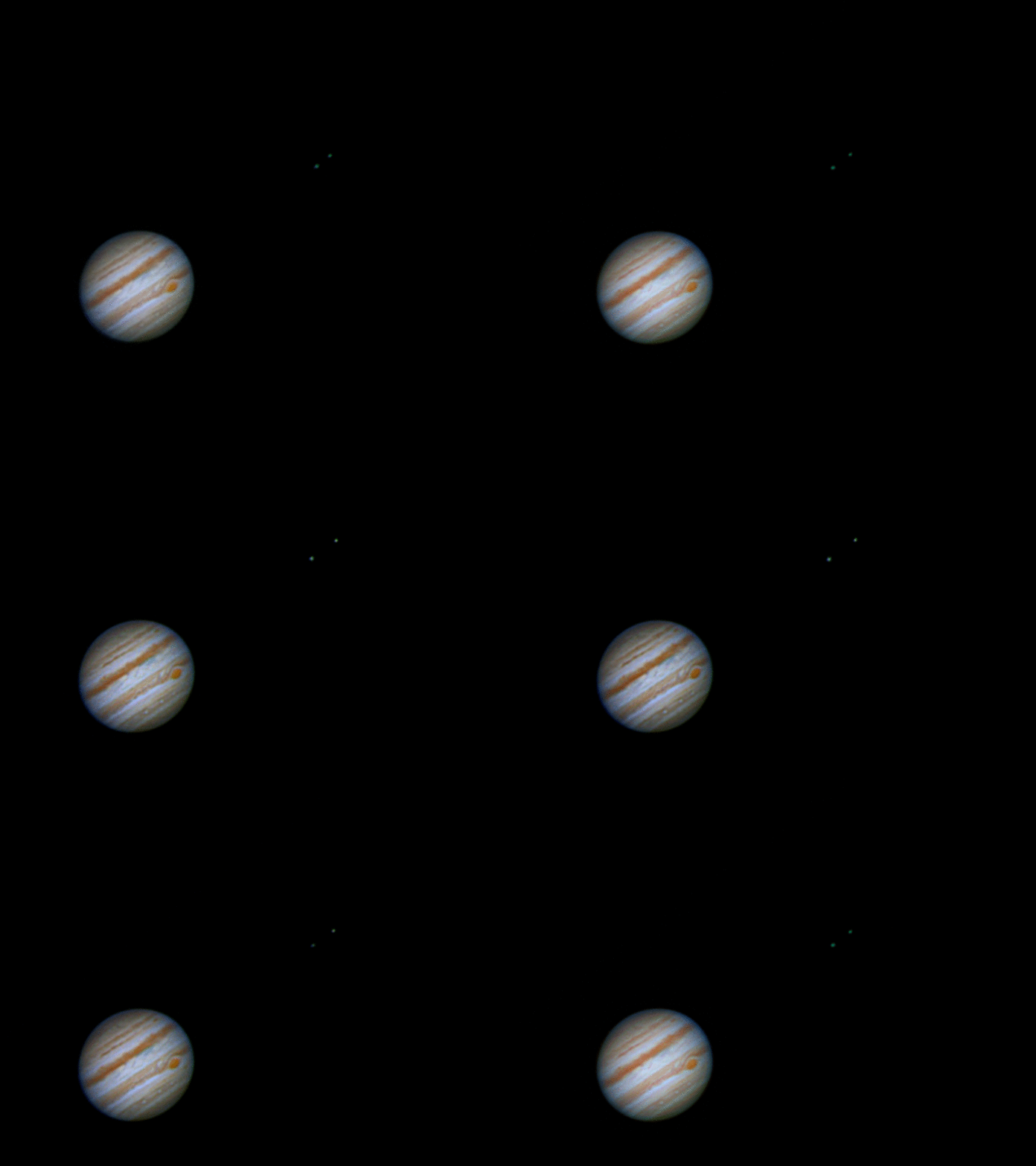
Jupiter Rotating – 2014.11.03. Dawn

Jupiter, Europa and Io

Jupiter, Europa and Io

I filmed the giant Jupiter a whole night as its Great Red Spot entered and left view. I also filmed Io exiting from behind Jupiter then move away and Europa moving towards the planet. And put all data together to show it as a time lapse movie.

Setup and metadata

I used my known setup: the 150/750 newton scope on the motorized EQ3 mount, a 2x barlow + extension tube (another barlow tube with the lens removed) + Scopium webcam (640×480, 8 bits RGB). I disassambled and adjusted the barlow+extensino tube+webcam assembly two times during the night to get the most out of the setup in terms of a great disk photo, knowing when putting all the frames together compensating for the rotation, xy offset and size will be only a small fraction of my problems.

To be noted that the observation started with Jupiter relatively low, near the horizon (about 30 degrees, in a city) and that the seeing varied substantially during the session, peaking at an almost perfect seeing, one I’ve never seen before from within this city.

I took the first video on November 3rd, 2014 at 0:53 UTC and the last one at 4:36 UTC. Location: Kolozsvár city, Romania, EU.

The setup (this was taken on October 10, 2014)

The setup (this was taken on October 10, 2014)

Laptop with at least 100 GiB free space (this was taken on October 10, 2014)

Laptop with at least 100 GiB free space (this was taken on October 10, 2014)

The screen (this was taken on October 10, 2014)

The screen (this was taken on October 10, 2014)


(tovább…)


Moon and Sun: DSLR or webcam?

DSLR vs. webcam imaging the whole Moon

DSLR vs. webcam imaging the whole Moon

I had this dilemma: what to use to image the whole disk of the Sun or the Moon? Make full disk pictures with my DSLR – 60 frames tops – or record many little videos with my webcam and put the mosaic pieces together? On one hand it is how much time I am willing to invest and on the other, what output quality I am expecting.

The tech

SCOPE: I used my 150/750 on the motorized EQ3.
DSLR: it is a Canon 1100D (also known as the EOS Rebel T3), unmodified hardware but enhanced by Magic Lantern (thanks guys :) ). The sensor is a 12.20 Megapixels CMOS APS-C (pixel size = 5.2 μm), capable of outputting 14 bits deep raw (cr2).
WEBCAM: it is a Scopium webcam, 640×480 pixels 8 bits sensor, max framerate is 30 fps, video is recorded in raw mode (pixel size = 5.6 μm). (tovább…)


Hearing Kepler Data

Kepler: lehetséges bolygótranzitok

It looks like a planet

What is the outcome when a radio person bumps into the planet hunter Kepler’s data? Obvius: sounds come out. A tranzit is in fact a mini eclipse and these are the subtle variations in a star’s luminosity Kepler used to look for between 2009 and 2013. From Kepler’s data scientists concluded that there must be 17 billion earth-like planets in our galaxy (though they have a somewhat different opinion about this term than everyday people do).

The fun thing about Kepler is that through the citizen scientist project called planethunters we all can contribute or just browse the data. The huge pile of data. I dedicated a few days to the project and looked for planets myself looking at the plotted luminosities of stars. This is what I wanted to share on air.

(tovább…)


The Correlation of Weather and Web Site Traffic

"The Matrix ows you!"

„The Matrix owns you!”

I decided to write an article outside amateur astronomy, which is the main scope of this blog. Why? Cause I have the means and I find it fun :)

In this short paper I describe the correlation between the visitor traffic the website radiocluj.ro received and the weather conditions recorded in the geographically relevant area. My goal was to measure how much weather conditions impact visitor behaviour. I found that the general hunch (good weather-less visitors, bad weather-more visitors) is not only true, but weather has a ~20% impact on traffic, depending on the definitions used. With further refinement the findings described below might be used in a predictive manner to maximize the impact of an article, however this is outside of the scope of this paper. (tovább…)


animgif, ffmpeg, ImageMagick. Tutorial and Frontend

Graphical Interface (frontend) version:
animgif frontend zip date 2022-12-04T19:21:42+02:00


Szaturnusz, Cassini-rés. MC 102/1300, 268 frame-ből válogatott a Registax

Saturn and the Cassini division.  MC 102/1300, webcam, stack of 268 frames, Registax

I am nostalgic about those times when there was no, or at least much less black hat content on the internet. Search engines were as they were, but the results were valid. Free software was free, developed by developers, and the notion of bundleware, crapware, bloatware were like unknown. Today? Trojans, spyware and spamdexing wherever you look. This pisses me off, and this is the reason I wrote this article and developed the free software.
(tovább…)


Analemma of Kolozsvár City

VNP: Analemma

VNP: Analemma of Kolozsvár/Cluj-Napoca, Transylvania

I am the first photographer to take a picture of an analemma in Transylvania.

The phenomenon itself, the celestial path of the Sun during a year is quite easy to understand yet it is a challenge to photograph it, even in the digital era, being a project spanning over a long time. And I did it, well, a bit differently.

This article is a summary of the last solar year, also with the intention to possibly serve as a guide for those future photographers who might take the challenge.

(tovább…)


Jól kalibrált monitoron mindegyik számnál elkülönülő árnyalat látszik. Ha mégsem látszanak, akkor a megjelenített képek színhiányosan rajzolódnak ki. A monitort valószínűleg kalibrálni kell.

You should see distinct shades for each number. If those shades are not clearly visible, the displayed pictures will lack accuracy. Your display most likely needs to be calibrated (brightness, gamma, contrast etc.).