Monthly archives: szeptember, 2026

Another black lightning in oxygen

I caught a disk center flare in O I 7772, nine scans centered around UT 2026-09-09 09:05. The signal on the disk below has been amplified through continuum subtraction etc, and an artificial flat corrects most artefacts, to highlight the oxygen features: darkened-mottled plages, darkened chromospheric network, dark flares, prominences and light blankets on and beyond the limb. A hint of a filament is visible here, though other datasets shows more obvious filaments.
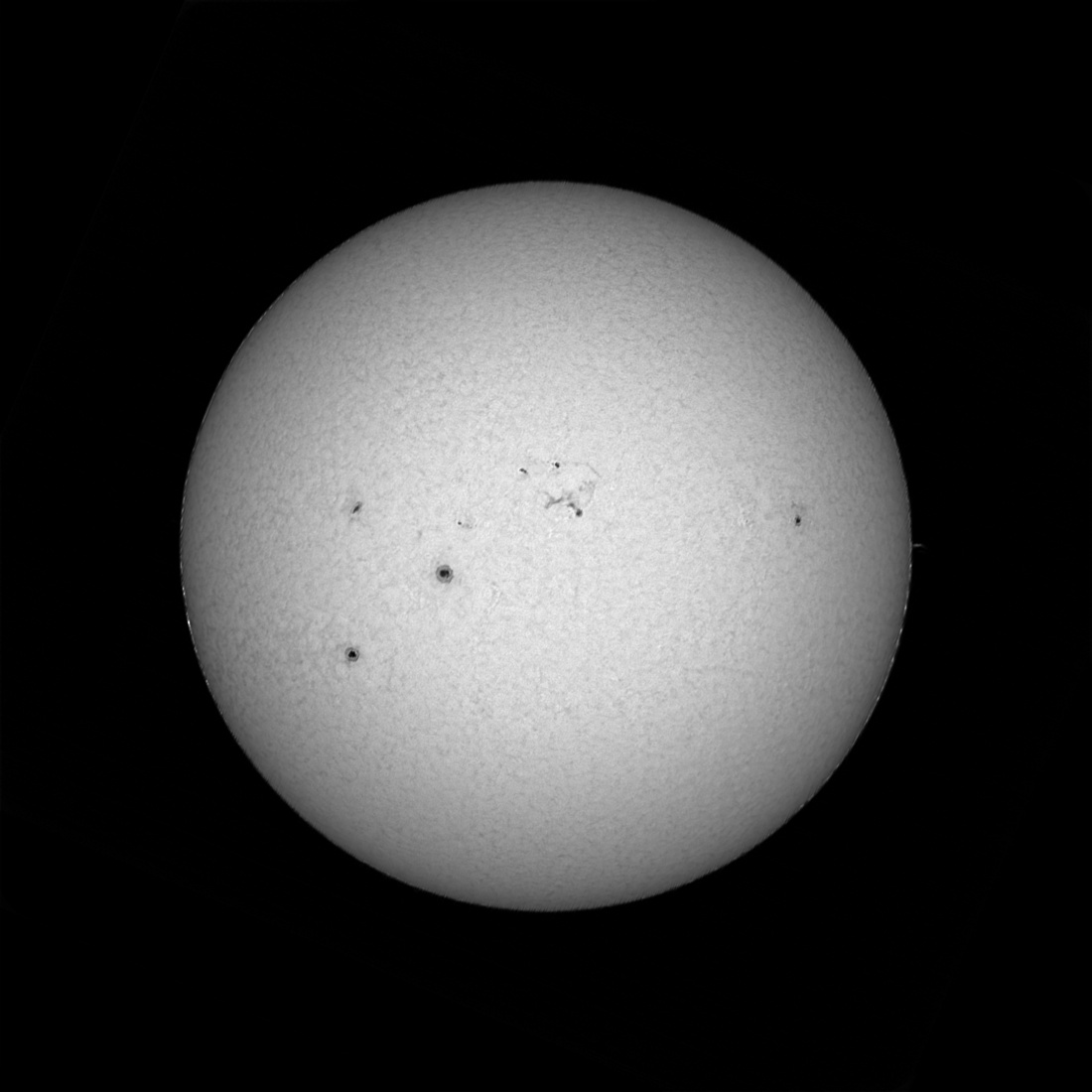
For reference, a GONG frame

(tovább…)


The Rotating Oxygen Sun

On 2026-09-20, I observed the Sun in O I 7772. I applied the same processing, applied an artificial flat to remove most artefacts. The two frames show considerable changes in the patterns shown by oxygen, while others rotate quietly together with the Sun.

The two frames are centered around UT 0800 and UT 1230, each frame is a stack of dozens of scans (around an hour).

As a bonus, the filament to the right of the disk center, is also obvious.

I used a modified Sol’Ex spectroheliograph, ML Astro Filter, EO 1800 gr/mm grating, and EO 775/25 OD4 bandpass filter, attached to a 72/430 refractor.


More filaments in oxygen

I observed the Sun in multiple wavelengths, Hα, He I 10830, O I 7772, and the disk center filament shows up rather obviously in the processed oxygen data.

I also tried hacking the Challenger Deep instrument, ultimately failing to improve its performance. The best addition proved to be yet another piece of black (both visually and IR) duct tape, covering a rogue area of the grating that’s perhaps rotated beyond its optimal angle.

O I 7772, false color, amplified via continuum subtraction, stack of data from multiple scans

O I 7772, false color, amplified via continuum subtraction, stack of data from multiple scans

O I 7772, amplified via continuum subtraction, stack of data from multiple scans

O I 7772, amplified via continuum subtraction, stack of data from multiple scans

single scan Ha

single scan Ha

single scan continuum around Ha

single scan continuum around Ha


Oxygen Smudge – with no bright EUV feature

Previously, as described in Smudges in Oxygen, O I 7772 I hinted at the fact that smudges in oxygen are usually accompanied by bright smoldering in EUV, and that the difference between AIA 1600 / AIA 1700 is a potentially good indicator of where to expect smudges.

In 2029-09-15, I collected data where a prominent smudge appears in oxygen, without anything outstanding in other wavelength. The smudge persisted for several hours, during which the area in question didn’t flare.

The smudge is the dark „spot” at around 9 o’clock, corresponding to a plage and filament in Ha.

(tovább…)


Sun, oxygen concept, with filaments

Stacking 12 scans, through continuum subtraction and further processing, I managed to reveal some really subtle details on the Sun, clearly showing filaments in Oxygen. Somewhat ironically, on this day, there were no flares, no smudges and no bright prominences, to add to the repertoire of the image presented here. I included AIA 1600, GONG and AIA/SUVI 304 for reference.

I consider it settled: there are filaments in oxygen, in O I 7772, on the disk of the Sun, and a Sol’Ex derivative amateur spectroheliograph can observe them.

(tovább…)


Jól kalibrált monitoron mindegyik számnál elkülönülő árnyalat látszik. Ha mégsem látszanak, akkor a megjelenített képek színhiányosan rajzolódnak ki. A monitort valószínűleg kalibrálni kell.

You should see distinct shades for each number. If those shades are not clearly visible, the displayed pictures will lack accuracy. Your display most likely needs to be calibrated (brightness, gamma, contrast etc.).